It starts with the people
For all the technology that underpins modern military training, the single most important element remains the people who deliver it. The instructional staff supporting RAF Typhoon training are overwhelmingly former service personnel, who bring thousands of hours of operational experience into the classroom, the briefing room and the simulator.
The scale is significant. BAE Systems trains roughly 500 engineers a year alongside the pilot pipeline. These teams of technicians and specialists need skills to be equally sharp as those in the cockpit. The Formula One analogy applies: the driver gets the limelight, but it is the whole team that delivers performance.
The evolution of synthetic training represents one of the biggest shifts in how the RAF prepares for operations. A generation ago, simulators served a narrow purpose. Back then a pilot might visit the simulator once a month to practise emergency procedures, like engine failures, fires or system malfunctions. That was essentially it. On Typhoon, simulators are an integral part of operational training, used not just for emergencies but for tactical mission rehearsal, collective training and the development of combat judgement.
The key has been understanding what each training domain does best. In the synthetic environment, you can go anywhere in the world, at any time of day or night, facing realistic threats in a secure setting where tactics are not exposed. Scenarios are repeatable, drawing out lessons that a single live sortie cannot.
But the live environment offers things that no simulator can replicate. There is a fear factor: no matter how immersive the simulation, a pilot knows deep down they are not going to crash into the North Sea at supersonic speed. There is real-world friction: sun in your eyes, mist on the windscreen, a slippery runway. And there is physiology — pulling 9G hurts, and pilots need to do it regularly to stay conditioned.
A new generation of simulators
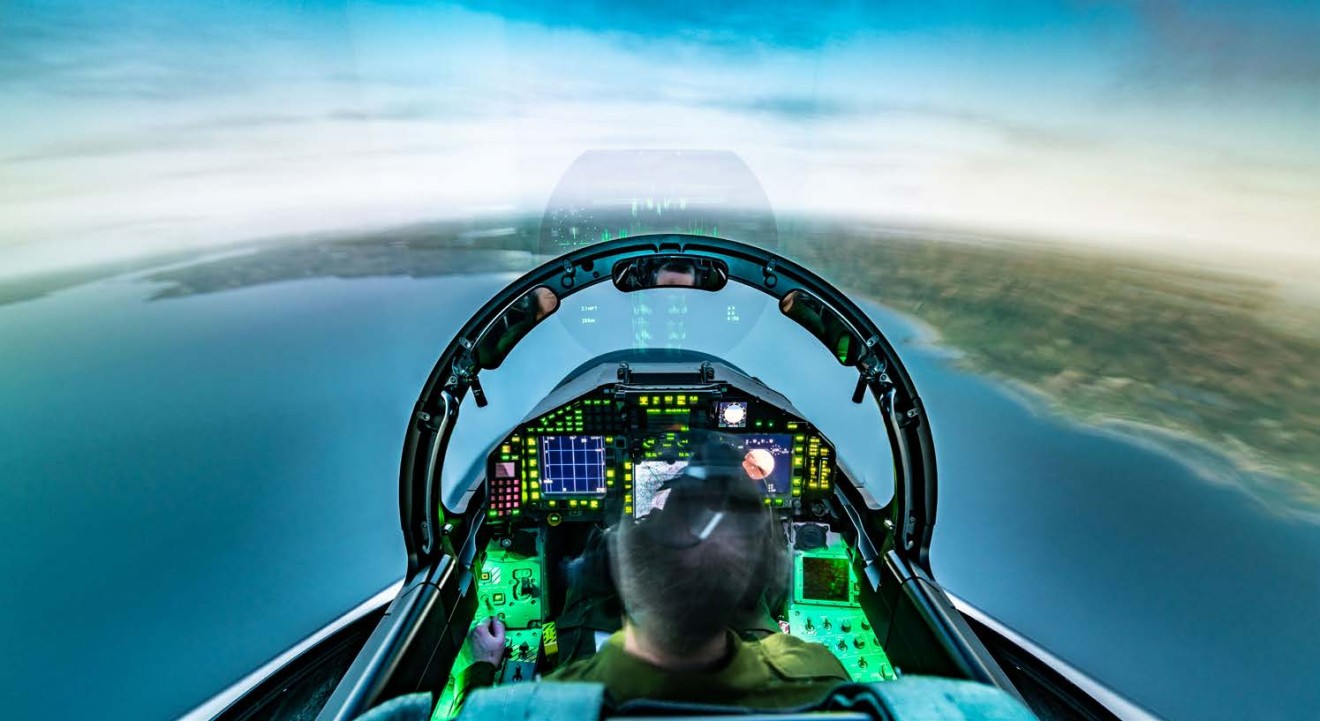
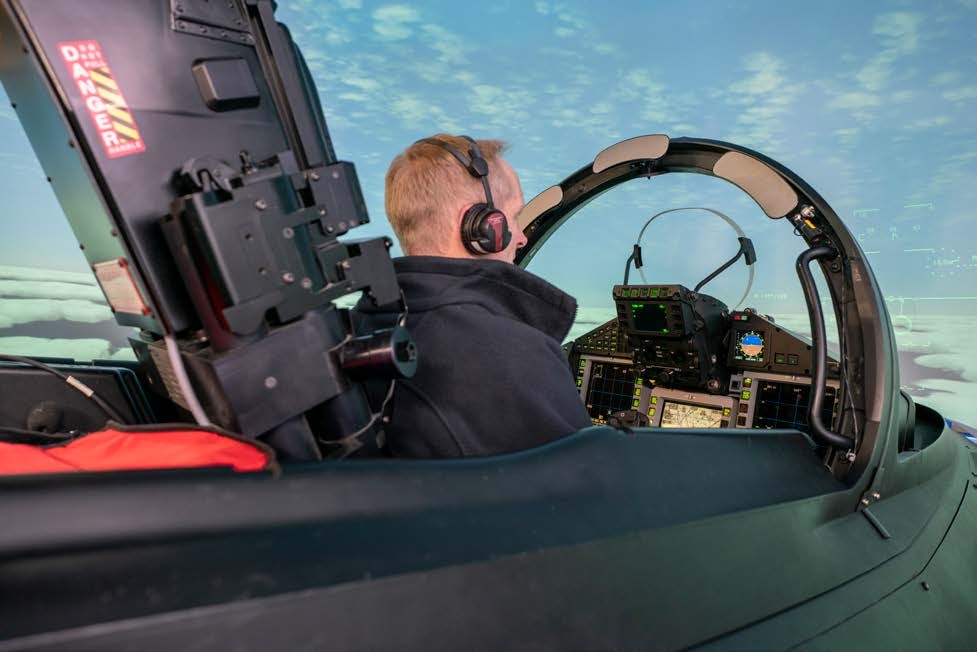
The latest Typhoon simulators, currently being integrated and rolled out, represent a significant step forward in three respects. First, fidelity. A 360-degree dome with external projection onto a translucent surface gives the pilot a completely unimpeded view from inside the cockpit. The effect is fully immersive and it feels like the real aircraft.
Second, concurrency. When simulators lag behind the aircraft standard, pilots risk learning the wrong lessons, wrong hand positions, wrong information layouts, or wrong decision baselines. The new simulators are designed to maintain lockstep with the aircraft as it continues to develop. Third, connectivity. Through a new RAF programme, the simulators will connect across multiple sites and platforms, enabling collective training on a scale previously only possible in the live environment — with all the benefits of repeatability, threat realism and security that the synthetic world provides.
Three ways to train
One of the most significant evolutions in Typhoon training philosophy is the way the RAF now defines three distinct modes of simulator use.
The first is part task training: pure repetition, free of scenario or context. An intercept repeated ten times. A procedure drilled until it becomes muscle memory.
“The new simulators are designed to maintain lockstep with the aircraft as it continues to develop."
The purpose is to automate core skills so that cognitive capacity is freed up for higher-level decision-making — the same principle as an athlete in the gym building the physical foundation that allows them to perform under pressure.
Modern simulators capture everything, every input, every decision in digital form. The potential of AI to analyse that data, identify patterns and feed tailored insights back into individual training programmes is, frankly enormous.
The second is training for training: replicating peacetime exercises in the simulator before doing them for real, with all peacetime rules applied. When the RAF prepare for exercises like Red Flag, pilots fly the scenarios in the simulator first — so that by the time they arrived, the unfamiliar had already become familiar.
The third is training for operations: the real thing, without peacetime constraints. Real missiles loaded on the aircraft. No artificial height separation from adversaries. When a pilot is shot down, they disappear and stop communicating — just as they would in reality. This is where pilots learn to make decisions based on what they would actually do, rather than what peacetime safety rules allow.
Only in the synthetic environment can all three of these modes be delivered safely, securely and repeatedly. It is a world away from my old monthly emergency session on the Jaguar.
What comes next
It’s all about data. Modern simulators capture everything, every input, every decision in digital form. The potential of AI to analyse that data, identify patterns and feed tailored insights back into individual training programmes is, frankly enormous.
For an aircraft still coming off the production line, maintaining the pace of training development is not optional. Just as Typhoon’s mission sets continue to expand, from quick reaction alert to the emerging challenge of countering drones.
Each demands its own knowledge, its own skills, its own training. Behind every one of those million flying hours, and every hour still to come, sits a training system designed to ensure that pilots and engineers are ready for whatever they face.