Background Information
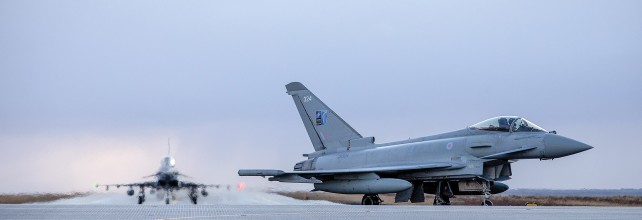
The operational requirements for Eurofighter Typhoon were agreed by the Chiefs of Air Staff of Germany, Italy, Spain and the United Kingdom in the form of a European Staff Requirement which was re-affirmed in January 1994.
The agreement, the basis for the project's development programme, defined the requirement for an extremely agile fighter that will dominate the skies to the mid-21st Century - a single seat, twin-engine fighter with optimal performance in Beyond Visual Range (BVR) and close combat, with significant ground attack capabilities.
Eurofighter Typhoon offers maximum operational effectiveness and flexibility, high survivability, extensive technological growth potential, as well as high reliability and maintainability with low operating costs.
Industrial consortia set up as part of the Project include:
- Eurofighter GmbH, set up to manage the development and production of the complete weapon system. It is owned by the four Eurofighter Partner Companies (EPC), with agreed development work shares:
- BAE Systems (BAES - UK) 33 %
- Alenia Aeronautica (ALN - Italy) 21 %
- EADS Deutschland (Germany) 33 %
- EADS CASA (Spain) 13 %
- Eurojet Turbo GmbH, set up by Avio (Italy), ITP (Spain), MTU Aero Engines (Germany), and Rolls-Royce (UK), to develop the EJ200 engine for the new fighter aircraft.
- Euroradar, a consortium brought together to design, develop and produce the advanced Captor radar, is comprised of EADS Defence Electronics (Germany), SELEX Sensors & Airborne Systems (United Kingdom), Galileo Avionica (Italy) and INDRA (Spain).
The NATO Eurofighter & Tornado Management Agency (NETMA) represents the Eurofighter partner nations' Governments and was established to oversee the procurement of weapon systems into the respective Air Forces.
Test Fleet
The Eurofighter Partner Companies built seven Development Aircraft (DA) for the Main Development Phase. These initial test aircraft have now completed their development tasks and have been withdrawn from the test programme.
Today, the test fleet comprises seven Instrumented Production Aicraft (IPA) and one Instrumented Series Production Aircraft (ISPA).
Germany:
The first Development Aircraft, DA1, made its maiden flight from EADS’ Manching test facility, Germany, on 27 March 1994 and was decommissioned 21 December 2005. It is now on display in the Aviation branch of the Deutsches Museum in Oberschleissheim, Munich.
DA5 made its first flight in February 1997. It contributed considerably to the Captor radar programme as well as carrying out a series of very successful test flights with the Captor Active Electronic Scanning Array Radar (CAESAR) before being withdrawn on 30 October 2007.
IPA3 flew on 08 April 2002 and is used for test and evaluation of handling qualities.
IPA7, the first Tranche 2 Eurofighter Typhoon, took off for its maiden flight on 16 January 2008 and is used for Tranche 2 enhancements.
United Kingdom:
The first British Development Aircraft, DA2, made its maiden flight at BAE Systems’ Warton site on 06 April 1994, and was retired 29 January 2007. It is to go on display at the Royal Air Force Museum, Hendon.
The twin-seat DA4, the second BAE Systems Development Aircraft, first flew in March 1997 and was used extensively in the development of the avionics suite before being decommissioned on 13 December 2006. It is now used for training ground crew specialists for the Royal Air Force.
IPA1 began operations on 15 April 2002 and supports envelope expansion and carefree handling testing. IPA5 is being used for avionics testing since its first flight on 07 June 2004.
ISPA1 (BT005 from the Royal Air Force inventory) first flew on 11 May 2004 and is used by the Combined Industry/Customer Test Team trialling the DASS and the helmet, as well as the integration of the Laser Designator Pod (LDP).
IPA6 flew for the first time 01 November 2007. The aircraft is equipped with Tranche 2 avionics.
Italy:
DA3, based in Italy at Alenia Aeronautica, made its maiden flight from Caselle, near Turin, in June 1995 and conducted many of the firing trials of the Mauser cannon before retiring at the end of 2006. Its future purpose has not yet been determined.
DA7, first flight on 27 January 1997, was also a key player in armaments conducting many of the first missile-firing exercises before decommissioning on 30 September 2007.
05 April 2002 saw the first flight of IPA2. The aircraft continues to play a key role in communications, navigation and radar development as well as engine testing for the Tranche 2 standard EJ200.
Spain:
EADS' two-seater DA6 made its first flight in Spain on 31 August 1996. It was lost 21 November 2002.
IPA4, the first single-seat production aircraft, took off for its first flight on 27 February 2004 and is used for tests on the environmental system, communication systems and MIDS, as well as for weapons testing including Meteor trials.
Radar
In mid-1996, trials were started for the integration of a new radar system into the Eurofighter aircraft. The Captor radar, developed by the Euroradar consortium, was initially tested in a BAC1-11 host aircraft off the coast of the UK, before being integrated into the main test programme and installed in prototypes DA4 and DA5. Production standard Captor radars are being delivered to the Eurofighter Final assembly lines in German, Italy, Spain and the UK since 2003.
In 2007, a series of very successful test flights with the Captor Active Electronic Scanning Array Radar was conducted with DA5 in Germany. The Euroradar consortium had previously tested this antenna in ground rigs and flown it in a BAC 1-11 trials aircraft.
Eurofighter GmbH and NETMA had agreed to use DA5 for this series of antenna test flights, using funding provided by the German Procurement Agency BWB through NETMA. The new antenna emphasises and demonstrates the policy of continuous capability enhancement in the Eurofighter programme, and production embodiment of this feature could be available for Tranche 3 or as a retrofit in Tranche 2 aircraft.
The Production Programme
The final aircraft requirement figures, agreed in January 1996, are 232 aircraft for the UK - and a 37,5% work share, 180 aircraft for Germany - and a 30% work share, 121 aircraft for Italy - and a 19,5% work share, and 87 aircraft for Spain - and a 13% work share.
The four nations reaffirmed their commitment to the Eurofighter project in December 1997 when the Memoranda of Understanding (MoU) covering Production and Support were signed by the four defence ministers in Bonn. NETMA and Eurofighter GmbH subsequently signed production and support contracts for the initial purchase of 620 aircraft on 30 January 1998.
On 18 September 1998, the Supplement 2 agreements to the production contract were signed in Munich. This fixed-price contract covers the production of the first Tranche of 148 aircraft.
Work on the first sub-assemblies for the first series production Eurofighter aircraft had commenced in late 1998 and deliveries to the customer started in Summer 2003. Eurofighter Typhoon entered service with all four nations in Spring 2004.
On 14 December 2004, the Tranche 2 production contract was signed for 236 aircraft and deliveries began in Autumn 2008. The proposal for a further Tranche of aircraft was submitted by Eurofighter GmbH to NETMA at the end of 2007.
In July 2003, Eurofighter GmbH signed the first export contract with Austria for delivery of 18 aircraft to start in 2007. This contract was revised in 2007 calling for delivery of 15 aircraft of Tranche 1 standard. In 2007 a second export contract for the delivery of 72 aircraft to the Kingdom of Saudi Arabia was signed on governmental level with the United Kingdom.
High Resolution images of the Eurofighter Typhoon can be downloaded from our web site. Hard Copy images are available on request.
For more information contact
Dr. Theodor Benien
Vice President Communications
Eurofighter Jagdflugzeug GmbH
Am Söldnermoos 17
85399 Hallbergmoos
Germany
Tel.: +49 811 80 1555
Fax: +49 811 80 1557
Mobile: +49 (0)160 93 99 38 40
theodor.benien @eurofighter.com

